Over 300,000 romance titles land on Amazon KDP every single year. That is not a typo. Three hundred thousand books, all competing for the same readers, the same search results, and the same precious seconds of a reader's attention before they scroll past.
And yet, so many authors - talented, dedicated, passionate authors - lose that battle before a single page is read. Not because their story is weak. Because their title is forgettable and their blurb reads like a school book report.
I know this because I have been that author. Back in 2014, I published a second-chance small-town romance that I was genuinely proud of. The story was good.
The cover was decent. The title?
Starting Over in Sweetwater Falls. It sold eleven copies in three months. Eleven.
My mum bought four of them. The problem was not the book.
The problem was that nothing about that title or blurb made a stranger stop scrolling and think, "I need that."
A strong title and a well-crafted blurb can increase click-through rates by up to 40%. Forty per cent more readers actually opening your book page. That is not a small number when you are self-publishing and every sale counts.
This is where AI comes in - and before you close this tab thinking this is about robots writing your books, stay with me. AI does not write your story. You do.
What AI does is act like a very fast, very well-read brainstorming partner who never gets tired, never judges your half-formed ideas, and can throw out fifty title options in the time it takes you to make a cup of tea. You stay in charge.
You make the final call. The AI just makes the thinking part faster and a whole lot less painful.
In this guide, you will learn how to beat blank-page syndrome by using AI to brainstorm romance titles that actually fit your subgenre and hook your target readers. You will walk through building blurbs that turn casual browsers into buyers, learn how to spot the telltale signs that a blurb was written by a machine, and polish the final result until it sounds completely, unmistakably human. There is even a section on how AI tools like BookNova AI are expanding what is possible for indie authors well beyond just titles and blurbs.
No tech background needed. No prior experience with AI tools required. Just bring your story idea and a willingness to experiment.
Staring at a blank document, trying to conjure the perfect title for your romance novel, is its own special kind of creative torture - and most authors have lost hours to it. AI changes that completely, not by replacing your instincts, but by flooding you with raw material fast enough to actually spark something. Here, you'll discover why AI handles the heavy lifting of brainstorming so much better than a solo late-night session ever could, and how writing the right prompt is the small skill that makes all the difference.
Outsmarting Blank Page Syndrome
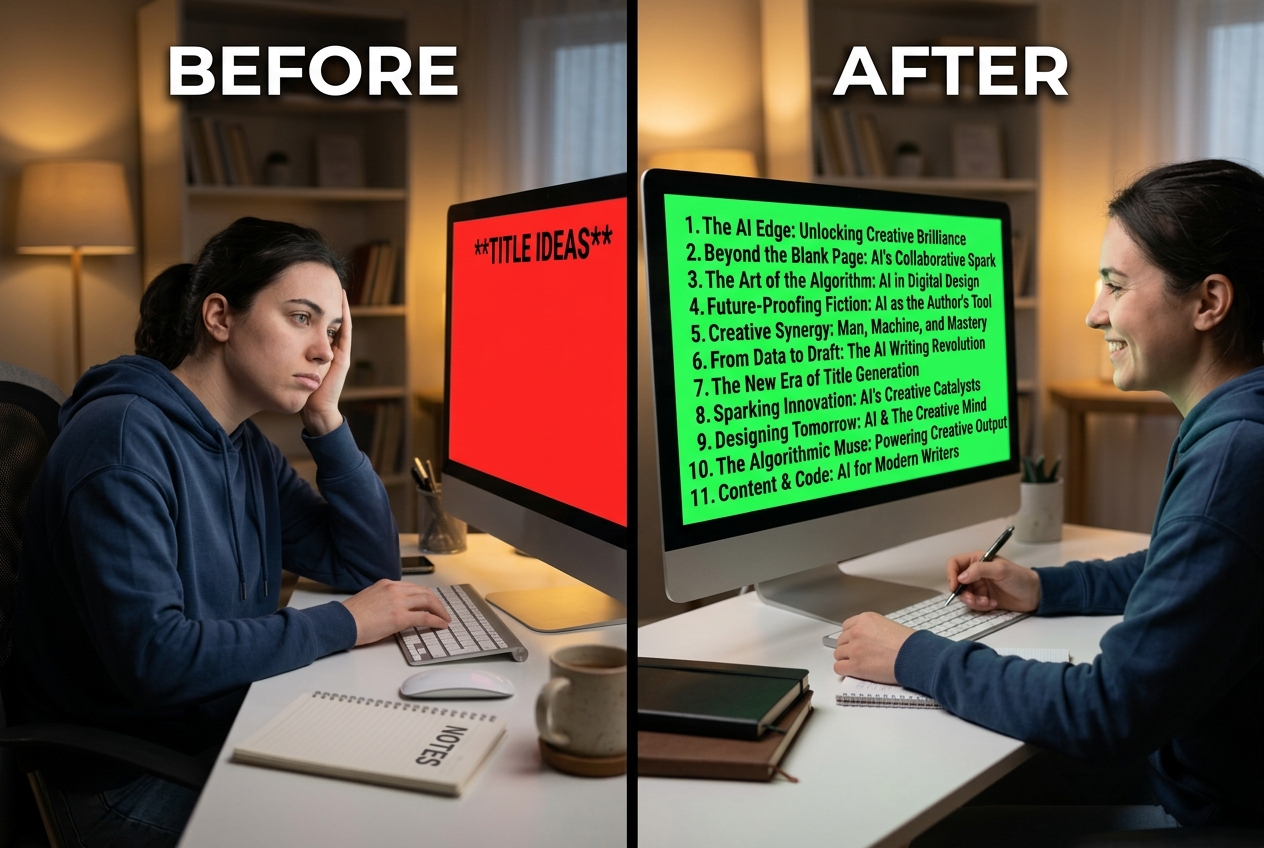
You open a new document, type "Title Ideas" at the top, and then stare at it for forty-five minutes while your coffee goes cold. Blank page syndrome - that particular flavour of creative paralysis where your brain simply refuses to produce anything useful - hits title brainstorming harder than almost any other part of writing. The stakes feel oddly high for just a few words.
Authors spend an average of 3 to 5 hours brainstorming titles manually. That's not 3 to 5 hours of productive flow. That's mostly staring, second-guessing, and Googling "best romance titles 2023" for the fourth time.
AI tools like WordWriter and Sudowrite generate suggestions in seconds. Not minutes. Seconds. That speed alone breaks the psychological deadlock, because your brain stops treating the blank page as a test it might fail.
A specific, detailed prompt - covering subgenre, relationship dynamic, emotional tone, and heat level - consistently produces 8 to 12 promising title options in a single generation, giving you real material to react to instead of nothing.
But this is where most people trip up immediately. A vague prompt produces vague results. Feed an AI "write titles for my romance novel" and you'll get something so generic it could belong to any of the 40,000 romance titles uploaded to Amazon last year. Generic input, generic output - every single time.
Specific prompts are a completely different story. When you include your subgenre (say, small-town contemporary), your relationship dynamic (enemies-to-lovers), your emotional tone (angsty, slow-burn), and even your heat level, the AI has actual material to work with. That's when you start seeing 8 to 12 options that feel genuinely tailored - titles you can actually react to, argue with, and build on. The details you feed in matter enormously, which is something worth sitting with before you type a single word into that prompt box.
I've tested this myself more times than I can count. My worst late-night experiment involved typing "historical romance, Scottish, dramatic" into a generator and getting back titles so painfully on-the-nose I actually laughed out loud. My best result came from a prompt that ran to nearly a paragraph. Night and day difference.
The psychology here is straightforward. Reacting is easier than creating from scratch. When an AI puts ten options in front of you, your brain shifts from "generate something" to "evaluate something." That's a much lighter cognitive lift, and it's exactly why the block dissolves so fast.
This isn't replacing your instincts as a writer - your knowledge of your own story, your readers, and what actually sells in your subgenre is what separates a usable title from a forgettable one. Tools like Sudowrite and WordWriter handle the volume; you handle the taste.
Crafting the Perfect AI Prompt for Titles
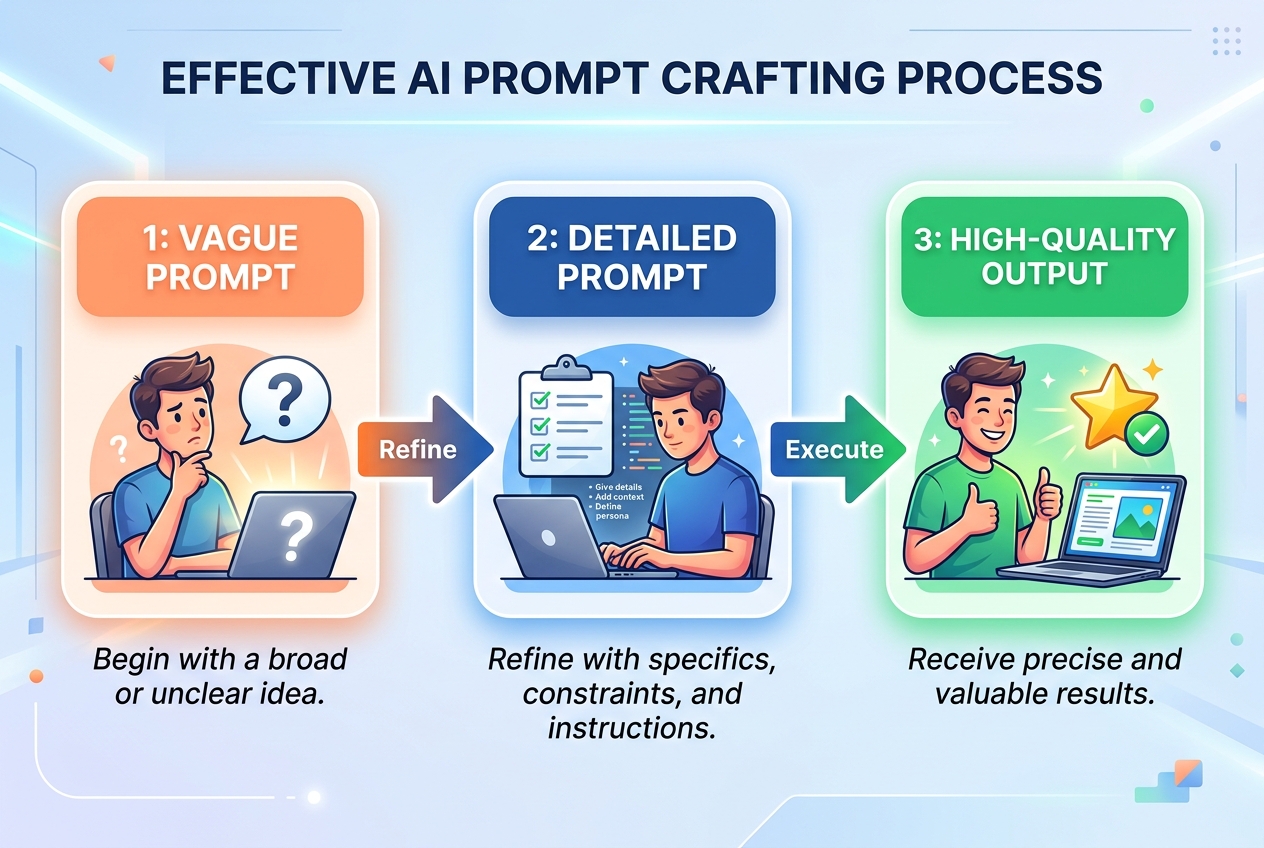
A vague prompt is a wasted prompt. Feed an AI tool something like "write a romance title" and you'll get exactly what you deserve: Love's Eternal Flame or some equally forgettable drivel. The prompt is where your creative authority lives, and every detail you include pushes the output further from generic and closer to genuinely usable.
So what actually belongs in a strong romance prompt? Quite a lot, as it turns out.
- Main characters - who they are, what they want, what's stopping them
- Setting - small-town diner, Scottish Highlands, a billionaire's penthouse
- Central conflict - the thing keeping them apart
- Relationship dynamic - enemies-to-lovers, fake dating, forced proximity, second chance
- Emotional tone - angsty, sweet, dark, lighthearted, slow-burn
- Subgenre - rom-com, dark romance, romantasy, historical, contemporary
- Heat level - closed door, steamy, explicit
- Themes - desire, longing, redemption, forbidden attraction
- Stakes - what they lose if love fails
That list isn't optional padding. Each element narrows the AI's output from thousands of generic possibilities down to something that actually fits your book. Skip the heat level on a dark romance prompt and you'll get titles that sound like Hallmark specials.
Here's the contrast that matters. A weak prompt: "romance novel about two people who fall in love." A strong one: "dark romance, morally grey male lead who is the heroine's bodyguard, enemies-to-lovers dynamic, high-stakes setting of organised crime, angsty and intense tone, explicit heat level, themes of obsession and protection." One of those generates titles you'd actually consider. The other generates titles you'd delete without reading.
Subgenre conventions deserve special attention. A rom-com title wants wordplay, lightness, a wink. A dark romance title wants weight - single words, possessive phrasing, something that feels like a warning.
Specifying the subgenre in your prompt tells the AI which shelf your book belongs on, which directly shapes the vocabulary it pulls from. You'll see this play out clearly once you start iterating on variations - that refinement process is where a good prompt pays off most.
BookNova AI's Story Thread Engine takes this a step further by tracking narrative elements - character arcs, relationship dynamics, subplot threads - so the titles it suggests stay consistent with the story's actual emotional DNA, not just its surface details. That kind of structural awareness makes a real difference when you're working with a complex plot.
One thing I've tested repeatedly: adding keywords for marketplace fit (think Amazon KDP search terms) inside the prompt itself shifts the output noticeably toward titles that perform in metadata, not just in isolation. It's a small adjustment with an outsized effect on discoverability.
The single most common mistake authors make is treating the prompt as a summary rather than a creative brief. A summary tells the AI what happened. A creative brief tells it what the book feels like - and that distinction is everything.
A romance title is the first promise you make to a reader, and getting it wrong is an expensive mistake I've made more than once. The good news is that AI can take you from a blank page to a shortlist of genuinely compelling options in minutes - but only if you know how to work with it rather than just accept whatever it spits out first. What follows will walk you through the practical steps of generating title ideas that actually fit your book, then show you how to test them against real reader reactions before you commit.
Five Steps to AI-Powered Title Gold
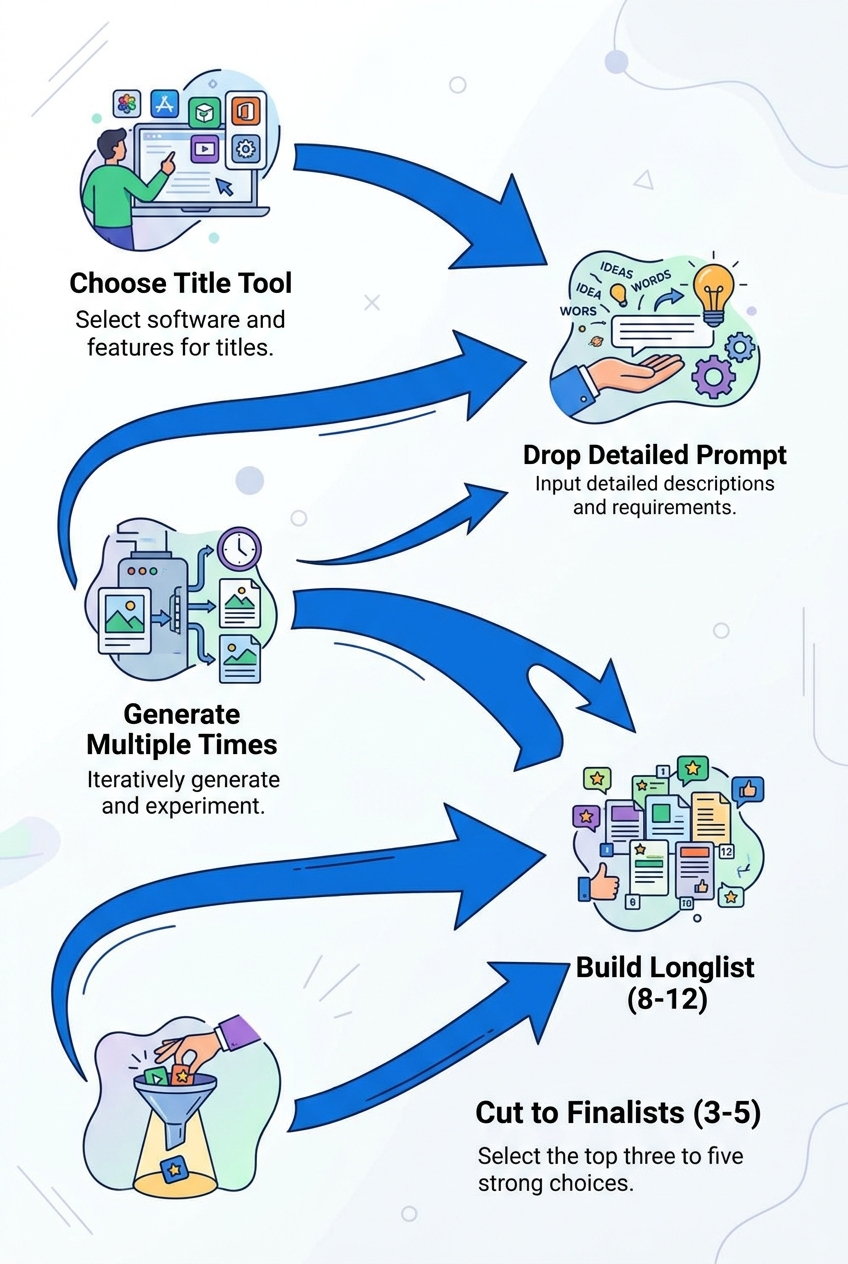
Authors who feed a detailed prompt into an AI title generator walk away with 20+ viable options in under 60 seconds. Authors who type "romance novel" get garbage. You already know how to write the detailed prompt - so let's talk about what happens after you hit generate.
- Choose Your Tool and Find the Title Template - Navigate to a dedicated title generator: WordWriter, Squibler, Writingmate, and Sudowrite are the four worth your time right now. WordWriter, in particular, has a specific "Book Titles" template that skips the guesswork about how to structure your input. Log in (or don't - several require no account at all) and find that template before you do anything else.
- Drop Your Prompt Into the Input Field - Paste the detailed prompt you built in the previous section, heat level and all. The AI needs your subgenre, relationship dynamic, emotional tone, and central conflict to produce anything worth reading. A half-built prompt produces half-built titles. This is the step most beginners rush, and it shows.
- Generate - Then Generate Again - Hit the button. Every tool on this list produces multiple suggestions instantly. Do not stop at the first batch. Run it two or three more times with minor tweaks - swap "lyrical" for "spicier," or add "YA-friendly" if you're writing for a younger audience. Each run surfaces different combinations you wouldn't have thought of alone. I once ran the same core prompt six times across two tools and found my actual series title buried in batch four.
- Build Your Longlist of 8 to 12 Options - Resist the urge to immediately crown a winner. Copy every title that makes you feel something - curiosity, excitement, even mild discomfort (sometimes that's the right signal for dark romance). You're aiming for 8 to 12 options at this stage. Whether a title will actually perform against competing books in your category is a separate question, one you'll need real reader data to answer - but right now, you're collecting raw material.
- Cut to 3 to 5 Finalists - Now apply your author brain. Read each title out loud. Does it sound like a romance? Does it match your subgenre's conventions - the possessive phrasing of dark romance, the warmth of small-town contemporary, the sweep of historical? Eliminate anything generic, anything that could belong to a thriller or a self-help book, and anything that makes you cringe for the wrong reasons. Your shortlist should have 3 to 5 titles you'd genuinely be proud to put on a cover.
The entire process - from opening the tool to a solid shortlist - runs 30 to 45 minutes if you work with intention. Longer if you fall into the rabbit hole of requesting variations, which, fair warning, is very easy to do.
At this point, you have a shortlist of titles that feel right to you. The uncomfortable truth is that "feels right to you" and "sells books" are not always the same thing.
Refining and Testing Your Top Choices
Your shortlist is a starting point, not a finish line.
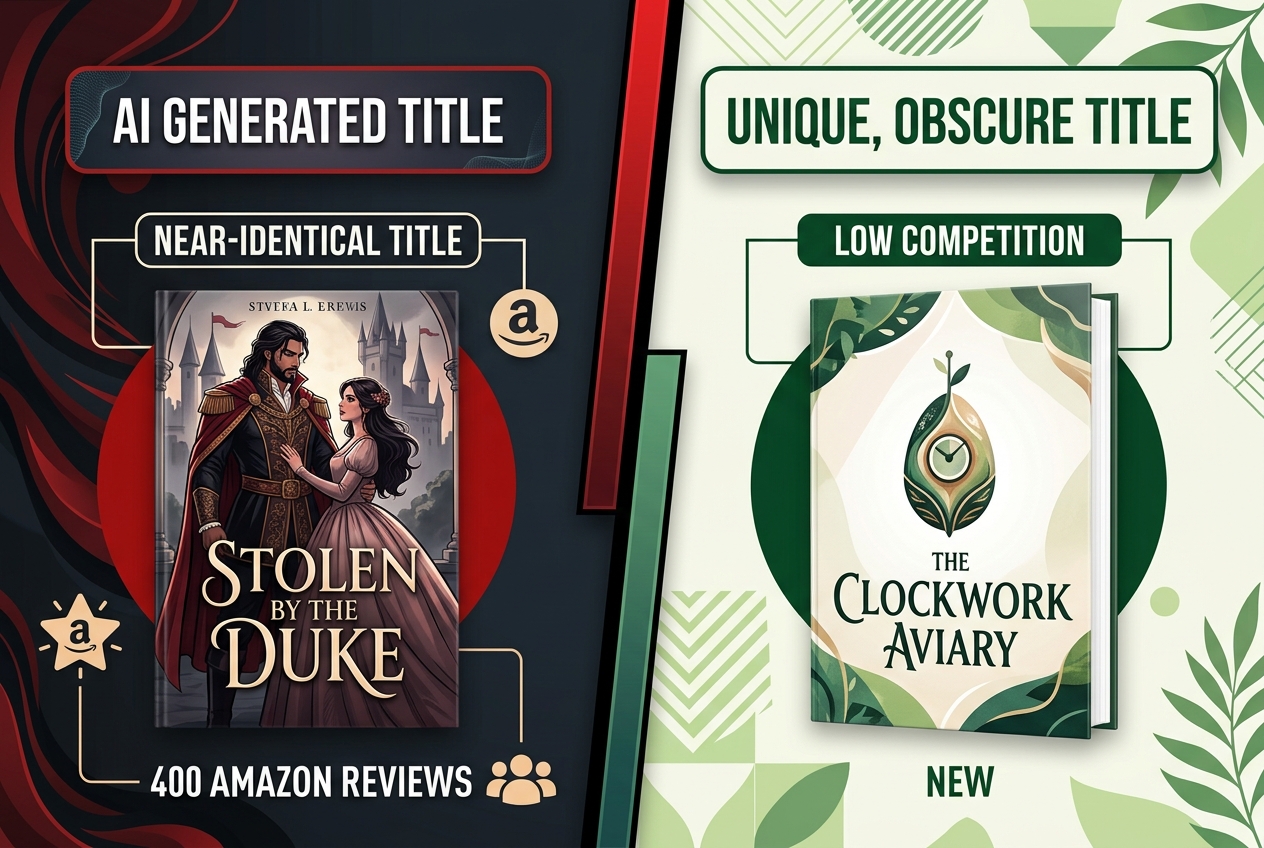
AI tools are genuinely good at volume - they'll flood you with options fast. What they can't do is tell you whether Stolen by the Duke is already sitting on page one of Amazon with 400 reviews, or whether your dark romance readers will find it too soft. That judgment call belongs entirely to you.
The first thing to check is marketplace availability. Head to Amazon KDP and search your top candidates directly. A title with heavy existing competition isn't automatically disqualified, but you need to know what you're walking into.
A near-identical title from a bestselling author in your subgenre is a problem. Obscurity is actually your friend here.
AI pulls heavily from existing titles when generating suggestions - which means your "fresh" output sometimes lands suspiciously close to a real book already ranking on Amazon. Always search before you commit.
Next, look hard at genre fit. A title that sounds literary and cool might read as completely wrong to someone browsing the dark romance or small-town categories. Romance readers have sharp instincts about what belongs in their corner of the market. A whimsical, breezy title on a book about obsessive love sends the wrong signal before the blurb even loads - and yes, the same problem shows up in blurbs too, which is worth keeping in mind.
Over-relying on trends is the other trap. AI tools are trained on what already exists, so they naturally gravitate toward what's currently popular. The result?
Titles that feel familiar in a bad way. Generic is the enemy of memorable. If three other books in your subgenre launched last month with "forbidden" in the title, your AI will happily suggest a fourth.
Once you've edited your shortlist down to three to five real contenders, test them. A/B testing - showing two options to a sample audience and measuring which performs better - sounds technical, but platforms like PickFu make it straightforward. A poll takes 10 to 15 minutes to set up, and results typically come back within a few hours to a day. You're not looking for a unanimous winner; you're looking for a pattern.
- Write your title options exactly as they'd appear on a cover
- Target romance readers specifically, not a general audience
- Ask respondents why they picked their choice - the comments are often more useful than the vote count
- Run at least two titles against each other, not a single option asking "do you like this?"
I've run PickFu polls where the title I was personally attached to lost badly, and the comments explained exactly why. That feedback is hard to replicate any other way.
Editing AI output isn't just about fixing awkward phrasing. It's about making a calculated decision - weighing market data, reader expectations, and your own knowledge of the book - that no prompt can make for you.
Your book's blurb is doing a sales job every single hour of the day, whether you're awake or not - and most authors write theirs like a school book report. A weak blurb loses readers before they ever reach chapter one. Here, you'll discover exactly what makes a romance blurb work on a psychological level, and how to use AI as your tireless copywriting partner to get there faster.
Think of it as learning the recipe before you let the robot bake the cake.
The Anatomy of a Killer Romance Blurb
A blurb is not a synopsis. This single distinction separates authors who sell books from authors who confuse browsers into clicking away. Your blurb is sales copy - its only job is to make someone tap "Buy Now."
Structurally, a high-converting romance blurb runs 150–250 words, split across 2–3 short paragraphs of roughly three sentences each. That's it. Not a chapter summary.
Not a character bible. A tight, punchy pitch that creates hunger without satisfying it.
Every effective romance blurb contains five non-negotiable elements: a strong opening hook, clear character introductions with motivations, a central conflict, the stakes, and a closing line that creates tension rather than resolution. Strip any one of these out and the blurb loses its grip.
The opening hook does the heaviest lifting. It needs to spark curiosity or desire in the first two sentences - because on Amazon, that's often all a reader sees before deciding whether to expand the description. Weak first lines kill sales before the story gets a chance.
Romance blurbs have one structural rule that other genres don't: highlight both protagonists. Readers want to feel the pull between two specific people, not just follow one character through a vague emotional crisis. The chemistry lives in the gap between them - your blurb has to make that gap crackle.
Stakes matter more than plot details. A reader doesn't need to know every complication your characters face - they need to feel what's at risk if love fails. Emotional stakes ("she'll lose the only home she's ever known") land harder than logistical ones ("they have thirty days to resolve the inheritance dispute").
There's also an SEO layer that most authors treat as an afterthought. Amazon indexes the first 200 characters of your book description, which means your subgenre keywords - "small-town romance," "enemies-to-lovers," "forced proximity" - need to appear early, not buried in paragraph three. AI tools, because you're already feeding them your subgenre and tropes as input details, can weave these terms naturally into a hook rather than cramming them in awkwardly.
One thing AI is genuinely good at here: structural discipline. Left to our own devices, most of us either over-explain the plot or write something so cryptic it means nothing. When you direct an AI generator with your characters, conflict, and stakes, it tends to produce blurbs that hit the required beats consistently - which is why the quality of what you feed it determines everything.
The blurb should never reveal your twist. Create intrigue, not a spoiler. End on unresolved tension - a question the reader can only answer by buying the book.
Getting the structure right is the easy part, though. The harder question is what specific information you hand the AI so it produces a blurb that sounds like your book and not a generic placeholder with your characters' names swapped in.
Feeding the AI for Magnetic Blurbs
Garbage in, garbage out. That rule applies to blurb generation just as brutally as it does to title prompts, and skimping on your input is the fastest way to get a blurb that reads like the back of every other book on the shelf.
The baseline information any AI blurb generator needs is straightforward: your book's title, its genre and subgenre, your main character or characters with their core motivations and struggles, the central conflict, what's actually at stake, and a brief plot summary. That's the minimum. Hand the tool less than that and you're essentially asking a stranger to describe your house after showing them a photo of the front door.
But the details that separate a forgettable blurb from a magnetic one go deeper. Your character's motivation isn't just "she wants love" - it's "she's sworn off relationships after her business partner destroyed her career and her engagement in the same week." That specificity gives the AI something to work with. The more concrete your input, the more the output sounds like your book instead of a template.
Include your character's specific wound or fear alongside their goal - not just what they want, but what's stopping them. That tension is what makes a blurb feel alive.
Some tools generate three distinct blurb versions from the same input. Hook-focused blurbs open with a punchy question or dramatic statement designed to stop a browser mid-scroll. Character-driven blurbs lead with the protagonist and pull readers in through emotional connection.
Situation-based blurbs drop the reader straight into the setup - the "here's the mess these two people are in" approach. Each style works differently depending on your subgenre, so generating all three and comparing them is worth the extra thirty seconds.
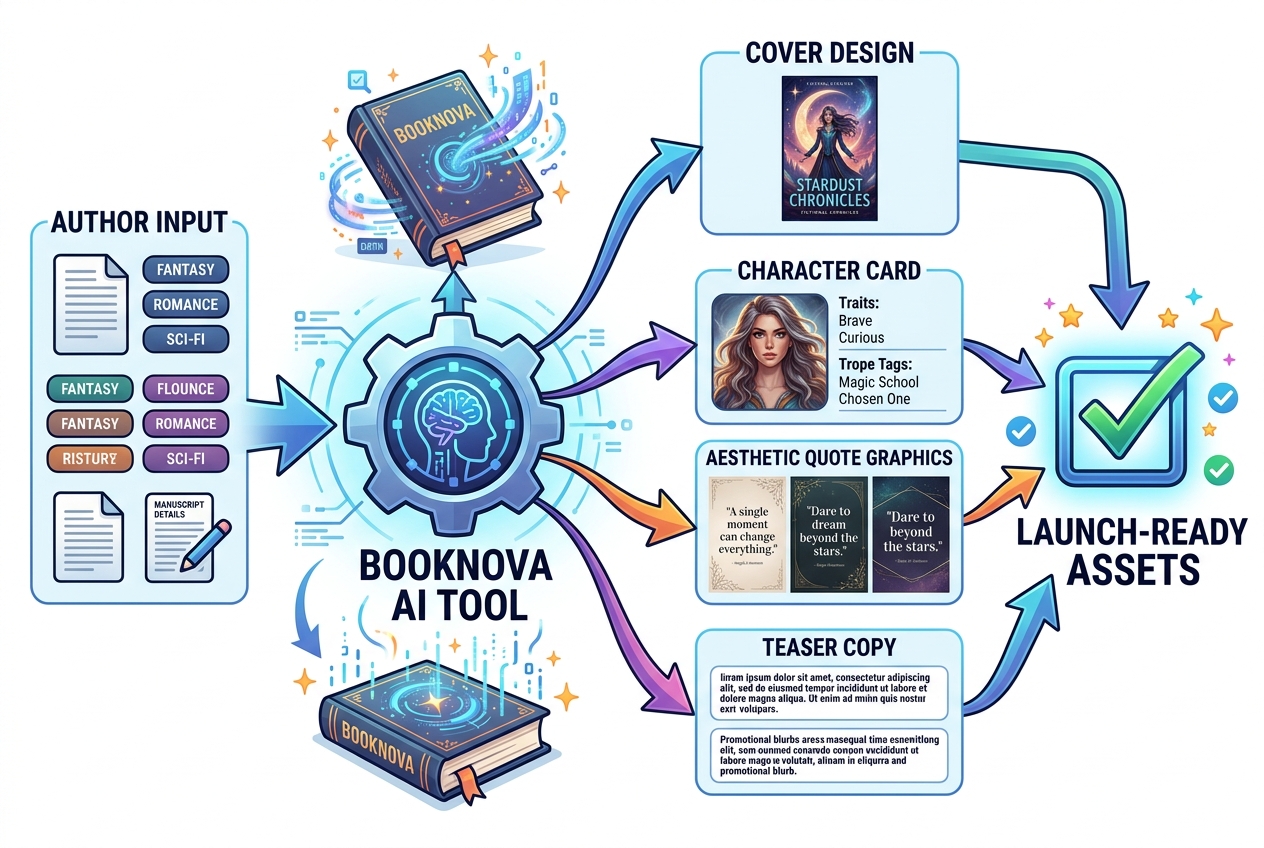
BookNova AI takes this a step further by generating a full Author Launch Kit alongside your blurb - including aesthetic quotes and teaser texts pulled directly from your manuscript. For authors who need promotional copy fast, having those assets built in removes a genuinely tedious step.
One thing worth doing before you even open a blurb tool: decide on the emotional core of your book. Not the plot - the feeling. Is this a story about learning to trust again?
About choosing yourself over the person you love? Write that down in one sentence and paste it into your prompt.
I've found that single line does more work than three paragraphs of plot summary, because it steers the AI toward tone rather than just events.
A quick note on refining as you go - most authors find the first generated blurb is about 70% of the way there, and the real work happens in the editing pass, which is a whole conversation in itself.
Skip the vague and go specific every time. "A forced-proximity romance set on a remote Alaskan research station" will always outperform "a romance where two people are stuck together." The AI can only mirror the precision you bring to it.
Getting a usable first draft from an AI blurb generator is genuinely satisfying - right up until you read it back and notice your brooding hero has "obsidian eyes" and your heroine's "breath hitched" approximately four times in three paragraphs. That particular flavour of robotic romance-speak is what editors call 'AI-tell', and it is the fastest way to lose a reader before they have even clicked 'buy'. What follows will show you exactly how to spot those giveaways and cut them, then reshape what remains into something with real emotional pull.
Spotting and Eradicating 'AI-Tell'
Your AI has done its job - you have a blurb draft in front of you. Now comes the part where your judgment matters more than any prompt you typed.
AI-tell is the term editors use for phrases and patterns that signal a text was machine-generated rather than written by a person. In romance blurbs specifically, it shows up fast. Phrases like "obsidian eyes," "velvet voice," and "her breath hitched" are the holy trinity of AI romance clichés.
I have seen these exact three phrases appear across blurbs for completely different books - a Scottish highlander story, a billionaire office romance, and a paranormal shifter novel - all generated in the same afternoon. The AI does not know your book.
It knows patterns.
The problem is not just that these phrases are overused. It is that they are invisible to the AI but immediately recognisable to a romance reader who has browsed Amazon for more than twenty minutes. Generic language kills distinctiveness, and a blurb that sounds like every other blurb on the shelf gives readers no reason to click.
Where to Look First
Read your draft aloud - slowly. Your ear catches what your eye skips. Flag any phrase you have seen on another book's back cover. Flag any description so vague it could apply to a dozen different heroes. "Mysterious stranger" is not a character. "A love she never expected" is not a conflict.
Cross-check every specific detail in your AI blurb against your actual manuscript - older AI models in particular have a documented habit of inventing character motivations or plot points that simply do not exist in your story.
Beyond the purple prose, watch for structural repetition: two sentences in a row starting with "She" or "He," or every paragraph ending on a vague emotional statement like "but will it be enough?" AI defaults to these rhythms because they appear constantly in training data.
How to Replace What You Cut
Swap the generic for the specific. If the AI wrote "his piercing gaze," ask yourself what your actual hero's eyes do in a tense scene. Do they go flat?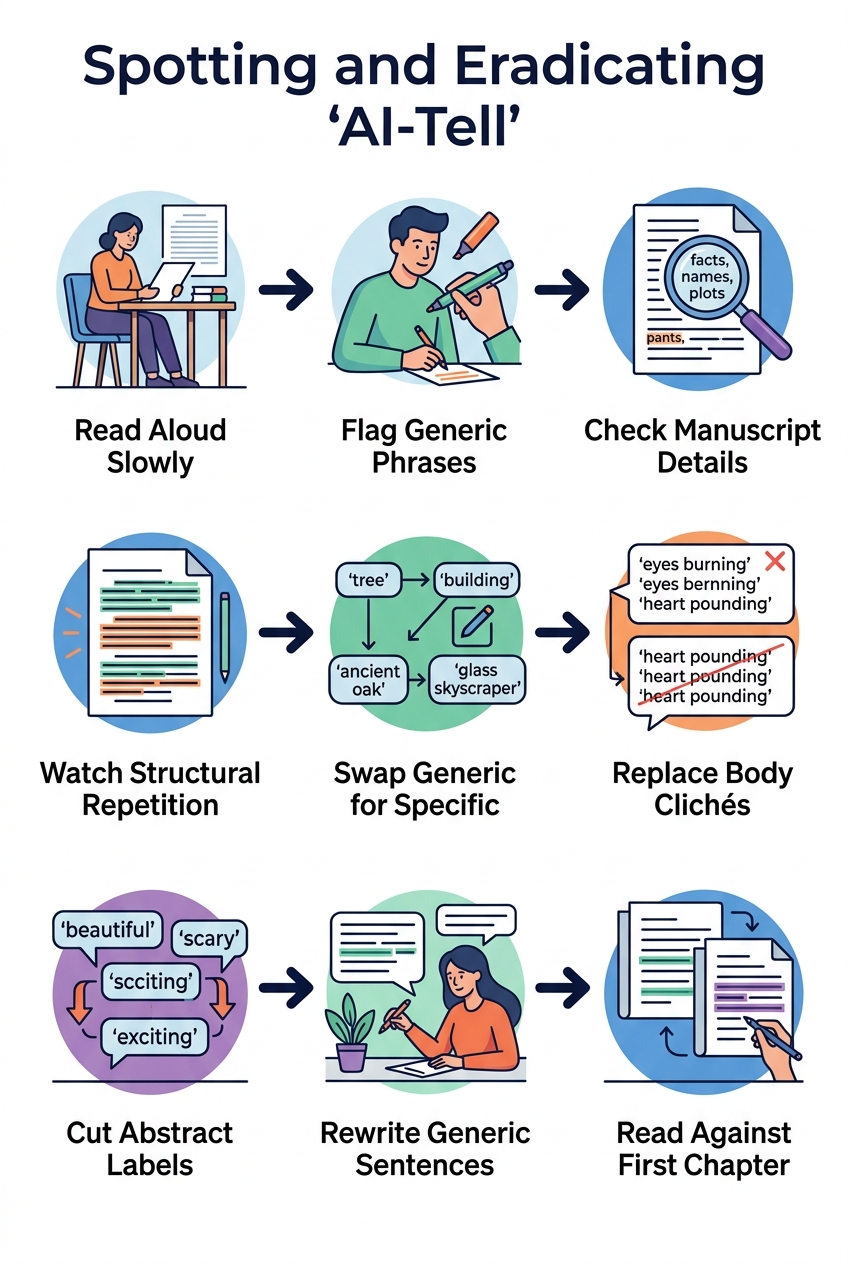
Does he look away first? That detail - the one only you know because you wrote the book - is what belongs in the blurb.
- Replace body-language clichés ("her breath hitched," "a shiver ran down her spine") with actions specific to your scene or character.
- Cut abstract emotional labels ("undeniable chemistry," "forbidden desire") and replace them with the concrete situation causing that feeling.
- Rewrite any sentence that could appear, word for word, in a different romance novel.
- Read the revised blurb against your first chapter - the voice should feel like the same book.
This editing pass is also a good moment to think about whether your blurb's dialogue and AI for romance banter are pulling in the same direction - the sharpness you want in one should echo in the other.
A blurb that sounds like you wrote it is not a small thing. It is the difference between a reader scrolling past and a reader buying.
The Final Polish: Tone, Tension, and Length
Stripping out AI-tell gets you a cleaner blurb. But clean isn't the same as effective. The next layer of work is about three things that separate a forgettable blurb from one that actually sells books: tone, tension, and word count.
Tone alignment is non-negotiable. A blurb written in breezy, rom-com energy for a dark, emotionally bruising second-chance romance will confuse readers - and confused readers don't buy. AI tools generate tone based on your prompt, but they often average it out, producing something vaguely romantic rather than specifically yours.
Read your blurb against the first chapter of your book. If the emotional register doesn't match, rewrite the blurb's opening paragraph first - that's where tone is set.
Tension is where most AI blurbs quietly fail. The tool wants to be helpful, so it summarises. It explains.
It resolves. Your job is to do the opposite.
A blurb's entire purpose is to build pressure and then stop - no payoff, no resolution, just a question the reader desperately wants answered. Focus on the central conflict and what's at stake, not the plot mechanics. End on tension or a cliffhanger.
If your closing sentence answers anything, cut it and stop one line earlier.
Length has a clear target: 150 to 250 words, structured as two to three short paragraphs of roughly three sentences each. That's it. Not a guideline - a proven format.
Too far below 150 words and the blurb lacks enough context to hook anyone. Push past 250 and you're writing a synopsis, not sales copy.
Some AI tools give you basic length controls in the prompt, but manual trimming is almost always needed. I've yet to generate a blurb that didn't need at least one paragraph cut down by hand - and I've run these tools through their paces more times than I care to admit.
When you think the blurb is done, read it aloud. This is the single most underused editing trick in the indie publishing world. Your ear catches what your eye misses - a rhythm that drags, a sentence that's trying to do too much, a closing line that lands flat.
If you stumble while reading it, your reader will stumble while processing it. Fix the stumble.
One practical checklist before you call a blurb finished:
- Tone matches the book's emotional register
- Conflict is clear within the first paragraph
- No plot twists or resolutions are revealed
- Both protagonists are introduced (for romance)
- The closing line creates pressure, not closure
- Word count sits between 150 and 250 words
- Read aloud without stumbling
This polish phase is also where your authorial instinct becomes the deciding vote. AI handed you the raw structure; you're the one who knows whether the stakes feel real or just described. That distinction - felt versus stated - is something no prompt can fully capture, which is why authors who treat AI as one tool inside a larger publishing process consistently outperform those who treat it as a finishing line.
A blurb that nails tone, builds genuine tension, and lands inside the 150–250 word range will do more for your conversion rate than a cover tweak or a price drop. That's where to fix romance pacing instincts carry over - the same sensitivity to emotional rhythm that shapes a manuscript applies directly here.
Titles and blurbs are just the beginning - AI has quietly become one of the most versatile tools in an indie author's launch arsenal, and most writers are barely scratching the surface of what it can do. Once you stop thinking of it as a one-trick blurb machine and start treating it as a full creative partner, the whole publishing process shifts. Ahead, you'll discover how AI stretches far beyond words on a page, and what to do when it inevitably throws you a curveball.
AI Beyond Blurbs: Covers and Character Cards
Somewhere along the way, authors decided AI was a text tool. A writing assistant. A blurb machine. That assumption is already outdated.
The visual side of book publishing - covers, character art, promotional graphics - has historically eaten up serious money and time. A custom cover from a decent designer runs $200–$500 minimum. Character illustrations for BookTok?
Add another few hundred. And if you're a new indie author with twelve dollars and a dream, that math doesn't work.
AI-generated cover design changes that equation entirely. Tools like BookNova AI produce cover designs and custom illustrations as part of the book generation process - not as an add-on you pay extra for, but built into the workflow. No brief.
No back-and-forth with a designer. No waiting three weeks for a revision.
Covers matter more than most authors want to admit. A reader decides whether to click in under two seconds, and that decision is almost entirely visual. Getting a professionally formatted cover from the same tool that wrote your blurb isn't a compromise - it's just efficient.
But the feature I find genuinely clever is the Character Card. BookNova auto-generates cards that include an AI portrait of the character, their personality traits, and trope tags - things like "grumpy sunshine," "second chance," "forbidden romance." These aren't just cute. They're purpose-built for BookTok, Instagram, and Pinterest, where readers share and discover books through exactly this kind of content.
Posting a character card with a moody portrait and a "forced proximity / enemies-to-lovers" tag takes ten seconds. Building that same asset manually in Canva, sourcing stock art, writing the copy - that's an hour you don't have the week of launch.
BookNova's Author Launch Kit bundles all of this together automatically: character cards with portraits and trope tags, aesthetic quote graphics pulled directly from your book text, and teaser copy ready to paste into a caption. The whole package generates the moment your book is ready. No Canva.
No designer. No extra work - their words, and in my experience, accurate ones.
Aesthetic quotes and teaser texts deserve a mention here because authors consistently underestimate them. A single well-framed quote graphic on Pinterest can drive more pre-orders than a week of cold outreach. Having those assets generated automatically, formatted and ready, removes the friction that causes most authors to skip promotion entirely.
AI tools save hours or days of manual brainstorming - that's the standard line, and it's true. But the bigger shift is what happens when you stop treating AI as a writing tool and start treating it as a full production pipeline. Text, visuals, and promotional assets, all from a single input.
One caveat worth flagging early: the output quality depends entirely on what you put in. Weak prompts produce generic covers and flat character portraits just as reliably as they produce bland blurbs - a pattern you'll run into repeatedly across every AI tool you use.
Troubleshooting Common AI Roadblocks
Generic output is the fastest way to waste an afternoon. You run your prompt, the AI spits back something like "A Love Unexpected" or "Hearts Entwined," and you stare at the screen wondering if you've just paid for a fortune cookie. This happens constantly, and it's almost always a prompt problem, not a tool problem.
The fix is specific input. Swap vague descriptions for the details that actually define your story: your protagonist's name and flaw, the relationship dynamic (enemies-to-lovers, forced proximity, second chance), the emotional tone, and your subgenre. "Contemporary small-town romance with a grumpy hero and a sunshine heroine, high heat, angsty" will get you somewhere. "Romance novel" will not.
The "AI-Tell" Problem
Repetitive phrasing is a dead giveaway. Readers notice it before they consciously register why the blurb feels off. Phrases like "his eyes darkened with intensity," "her breath hitched," or "a shiver ran down her spine" appear so often in AI output that they've become the literary equivalent of a spam filter trigger.
No tool will fix this for you. Manual editing is the only answer. Read your blurb sentence by sentence and cut every phrase that sounds like it belongs in a hundred other books.
AI-generated blurbs often recycle the same structural patterns across multiple outputs - not just the same words. If your hook, character intro, and cliffhanger all follow an identical rhythm, rewrite the structure, not just the vocabulary.
When the Length Is Wrong
A blurb should land between 150 and 250 words across 2-3 short paragraphs. Too long and you've written a synopsis. Too short and you've written nothing.
If your AI output misses that range, you trim or expand manually, keeping only the hook, character motivation, central conflict, stakes, and cliffhanger. Everything else goes.
When It Feels Emotionally Flat
Flat blurbs come from flat prompts. If you asked for a blurb without specifying the emotional journey - the longing, the push-pull, the moment everything nearly falls apart - the AI had nothing to work with. Go back to your input and add the emotional beats explicitly. Then ask for stronger language around the chemistry and tension.
Making the Final Call
Faced with five decent options, most authors freeze. Don't. Here's how to break the deadlock:
- Use a scorecard - Rate each option on memorability, genre fit, emotional impact, and curiosity. Assign a number, 1-5, to each criterion. The highest total wins.
- Run an A/B test - Platforms like PickFu let you poll real readers fast. Set it up in 10-15 minutes and get results within hours.
- Fact-check everything - AI hallucinates. I've seen generated blurbs include plot details that flat-out contradict the manuscript. Read every line against your actual story before it goes anywhere near a product page.
Scorecards remove the emotion from a decision that feels intensely personal. That distance is the point.
Conclusion
AI doesn't write your book. It doesn't know your characters the way you do, and it certainly doesn't feel the slow-burn tension you've been building since chapter two. What it does is hand you a stack of raw material in seconds - and then get out of your way.
That's the whole game here. You stay in charge. AI just stops you from staring at a blank document for three hours trying to decide whether "Forbidden Hearts" sounds too on-the-nose. (It does, by the way. Ask me how I know.)
Here's what's worth holding onto from everything we covered:
- Vague prompts produce vague titles. Feed the AI your subgenre, heat level, relationship dynamic, and emotional tone - and you'll get 8 to 12 genuinely usable options instead of five variations of "Love in the Shadows."
- AI saves hours of manual brainstorming, but the final call is always yours. Generate fast. Decide slowly.
- A blurb is sales copy, not a summary. If your AI-generated blurb tells the reader how the conflict resolves, delete that part immediately.
- Read the blurb out loud. If you stumble over it, a reader will too. That's your signal to edit, not publish.
- "Obsidian eyes" and "her breath hitched" are red flags. If you spot them in your AI output, rewrite those lines in your own voice before the blurb goes anywhere near a product page.
Two things you can do today, right now, without overthinking it:
Open a free tool like Sudowrite or WordWriter, write a detailed prompt for your current work-in-progress - characters, conflict, subgenre, heat level, all of it - and generate your first batch of title options. Give yourself fifteen minutes. If you want to go further, try BookNova AI to generate a full Author Launch Kit alongside your book, including character cards and teaser texts built for BookTok and Instagram.
Then take your three favourite title options and run a quick PickFu poll. Real readers, real feedback, results within a day.
The technology is already there. The only thing standing between you and a title that actually sells your book is a well-written prompt and the willingness to edit what comes back.
Sources
- AI Book Title Generator - Free AI Tool — writingmate.ai
- Romance Book Title Generator — squibler.io
- wordwriter.co — vertexaisearch.cloud.google.com
- AI Romance Novel Chapter Title and Book Blurb Ideas Maker — writecream.com
- Fantasy Name Generator | Create unique names for your characters — sudowrite.com
- Free Book Blurb Generator - AI-Powered Book Description Tool (2025) — tools.mystoryflow.com
- Romance Novel Title Generator: The Ultimate Guide — skywork.ai
- How to Write a Romance Novel with AI in 2026 (Step-by-Step Guide) — inkfluenceai.com
- AI Book Title Generator: 9 Game-Changing Ways to Create Bestseller — aizolo.com
- automateed.com