A human developmental editor takes between 75 and 100 hours to work through a 100,000-word manuscript - and that's before you've written a single revision. AI can do the same structural analysis in under 15 minutes. That gap is hard to ignore, especially when you're sitting with a finished romance novel that you know in your bones isn't quite right, but you can't put your finger on why.
I've been writing romance for over a decade. I've drafted slow burns, enemies-to-lovers arcs, second-chance love stories - you name it. And I can tell you from painful experience that pacing problems are the sneakiest story-sized potholes on the road to publication.
Your manuscript is complete. The meet-cute lands.
The black moment wrecks you. The HEA earns its tears. But somewhere in the middle, the story stalls.
Readers put the book down. Not because they stopped caring - but because the story stopped pulling them forward.
That's a pacing problem. And it's more common than any author wants to admit.
AI won't write your love story for you. It won't feel the electric charge between your leads or know why your heroine's silence in chapter seven hits harder than any argument could. But it is remarkably good at spotting where your tension flatlines, where your scenes drag without purpose, and where your emotional beats arrive too early or too late. Think of it less like handing your manuscript to a robot, and more like giving it to a very well-read co-pilot who never gets tired and never misses a structural pattern.
This article walks you through the full process - from preparing your manuscript so AI can actually read it properly, to running a big-picture diagnosis of your entire story arc, to getting into the fine detail of individual scenes and even sentence rhythm. We'll also talk about where AI gets it wrong (and it does get it wrong), and why the final pass always belongs to you.
Traditional developmental editing costs hundreds, sometimes thousands, of dollars. That puts serious structural feedback out of reach for many self-publishing authors. AI doesn't replace that expertise entirely - but it closes the gap in a way that simply wasn't possible a few years ago.
If your romance manuscript is finished but something feels off, you're in the right place. Let's figure out what's wrong - and fix it.
Even the most devoted romance reader will quietly put down a book that makes them feel nothing - and nine times out of ten, pacing is the culprit. A manuscript that drags through the wrong moments, or rushes past the ones that matter, is riddled with story-sized potholes that quietly kill reader immersion before you ever reach the happy ending. Before you can fix the problem, you need to know what you're actually looking for - and understand why getting the rhythm right isn't just a stylistic choice, it's the whole beating heart of your story.
Spotting the Draggy Chapters
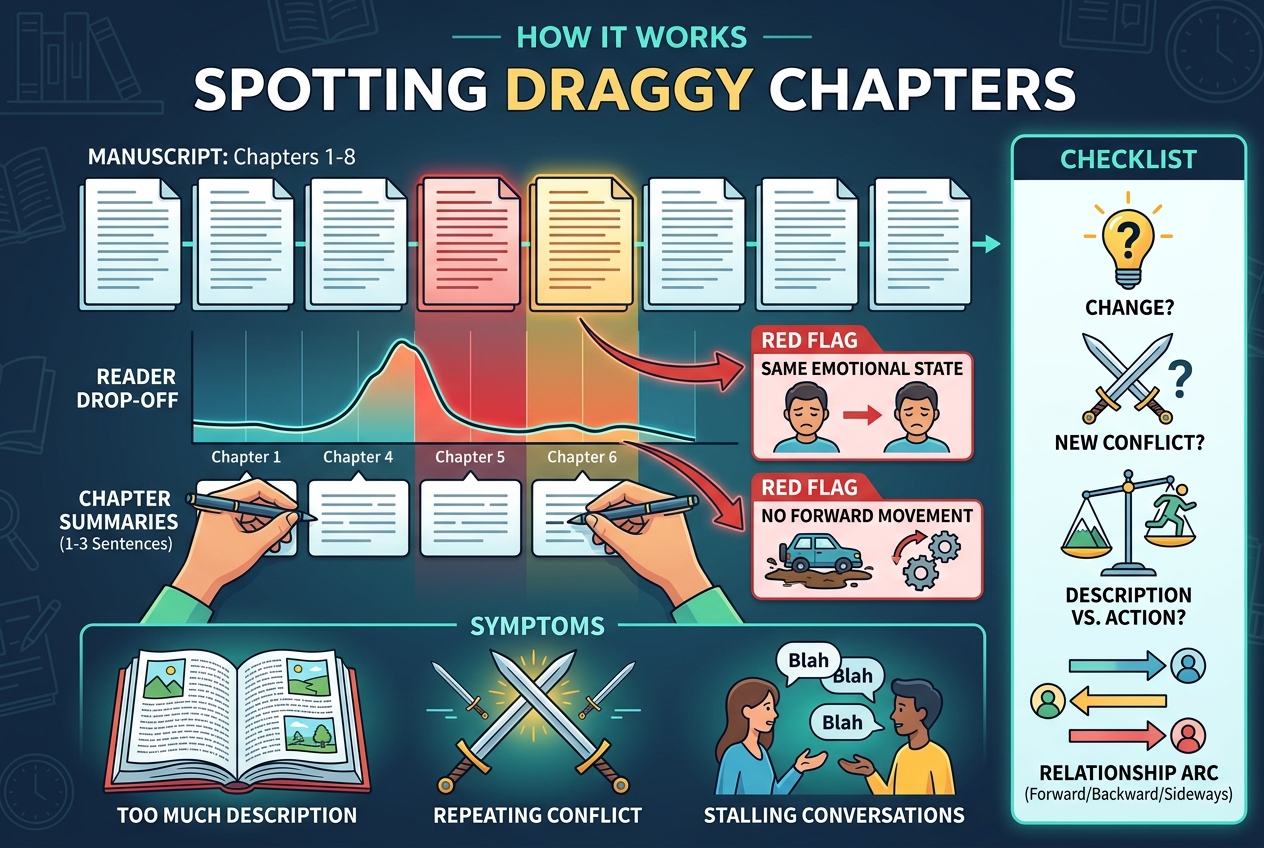
Draggy chapters are sections of a manuscript where narrative tension drops, conflict stalls, or description outpaces action, causing readers to disengage. They most commonly appear in chapters 3–6, where reader drop-off rates spike if rising tension isn't present to pull the story forward.
A completed draft sitting on your desk is a victory. But finishing isn't the same as working, and the gap between the two usually lives in a handful of chapters you already half-suspect are the problem.
The most common reader complaints - "nothing happens" and "too much description" - aren't vague feelings. They're symptoms. Slow pacing shows up in three recognisable forms: scenes that repeat emotional beats already covered two chapters ago, description blocks that run longer than the conflict they're supposed to frame, and conversations where characters talk around a problem without anything actually changing.
Romance readers carry specific expectations into every book, whether they know it consciously or not. A meet-cute or inciting incident belongs in chapters 1–2. Tension should be rising through chapters 3–6.
A crisis - the black moment - lands in chapters 7–8. If your structure doesn't roughly honour that shape, readers feel the drag before they can name it.
Start your audit the low-tech way. Write one to three sentences summarising each chapter: what happens, what changes, and what each character wants in that moment. No padding. If you can't identify what changes in a chapter, that's your first red flag.
Lay those summaries out and read them in sequence. You're looking for chapters where the summary sounds nearly identical to the one before it - same emotional state, same unresolved tension, no forward movement. Those are your draggy chapters. No algorithm needed for that diagnosis.
Pay particular attention to chapters 3–6. That's where reader drop-off rates spike hardest in romance manuscripts, and it's not a coincidence. After the meet-cute energy fades, the story has to earn continued attention through escalating stakes. If your chapter summaries for that stretch all read as variations of "they argue but nothing changes," you've found the pothole.
I've read manuscripts where chapters 4 and 5 were essentially the same scene in different locations - same push-pull dynamic, same unresolved tension, no new information introduced. The author couldn't see it from inside the draft. The chapter summaries made it obvious in under ten minutes.
Some writers find that a simple checklist helps them stay honest during this first pass:
- Does something change by the end of this chapter - emotionally, informationally, or in terms of stakes?
- Does this chapter introduce new conflict, or just repeat existing conflict?
- Is there more description than action or dialogue?
- Does this chapter move the relationship arc forward, backward, or sideways?
"Sideways" counts, by the way. A chapter doesn't have to escalate - but it has to do something irreversible. Stasis is the enemy.
This manual audit is genuinely useful, and I'd recommend every writer do it before reaching for any tool. But it has a ceiling. Chapter summaries show you where the drag lives; they don't always tell you why - whether the problem is sentence-level rhythm, scene structure, or a deeper issue with your story's tension architecture. That distinction matters more than most writers realise when they're deciding how to fix what they've found.
Why Pacing Is Your Romance Story's Heartbeat
Pacing controls how fast or slow a story moves, dictating when tension rises, when readers breathe, and when emotional payoffs land. In romance, it is the mechanism that builds sexual tension and emotional intimacy incrementally - get it wrong, and readers put the book down for good.
80% of romance readers cite "unputdownable" as a top quality they want in a novel. That single statistic should stop you cold. Readers aren't just hoping for a good story - they're expecting one that physically won't let them go.
Pacing is the engine behind that compulsion. It's not about how many words you write per chapter. It's about how much emotional weight each scene carries and whether that weight is building, releasing, or - the worst outcome - just sitting there.
Bad pacing breaks immersion. And broken immersion leads directly to DNF rates - "Did Not Finish," the two most crushing words in a reader's vocabulary. You already know how to spot the warning signs: chapters that feel waterlogged, scenes where nothing shifts, dialogue that circles without landing. The question is why those problems exist at a structural level.
Pacing dictates reader investment in your characters' arcs. When the tension between your leads rises at the right speed, readers become emotionally committed. They need to know what happens. Slow that tension down too much, and the investment drains away - not dramatically, but quietly, one distracted page at a time.
Here's a distinction that trips up a lot of writers: the difference between slow burn and simply slow. A slow burn is a deliberate, controlled choice. The tension between your leads is always present, always tightening, even when nothing overtly romantic is happening.
Every scene is doing work. "Slow," by contrast, means scenes are passing without advancing either the plot or the emotional connection. One is a feature.
The other is a story-sized pothole.
Romance has a specific structural rhythm readers expect, even if they can't name it. A meet-cute or inciting incident in the opening chapters. Rising tension through the middle.
A crisis - the black moment - that feels genuinely devastating. Then the resolution and the HEA (happily ever after).
Disrupt that rhythm in the wrong places and readers feel it, even if they can't articulate why the story lost them.
After reviewing manuscripts where pacing had gone quietly wrong, the pattern is consistent: the problem is rarely a single draggy chapter. It's an accumulation of scenes where the emotional stakes stayed flat. Good pacing builds sexual tension and emotional intimacy incrementally - each scene nudging both forward, even in small ways. When that incremental build stalls, the whole story stalls with it.
Tools like Marlowe and AutoCrit can benchmark a manuscript against successful romance novels to flag exactly where that build breaks down - a useful reference point when systematic diagnosis becomes the next step. But before any tool can help, you need to understand what a healthy heartbeat actually looks like, so you can recognise when yours has gone arrhythmic.
The harder question isn't whether your pacing is off. It's knowing precisely where - and that requires looking at your manuscript in a way most writers never do.
Before AI can give you useful feedback on your manuscript's pacing, it needs to understand your story - and that means doing a little groundwork first. Think of it like briefing a very sharp, very literal assistant who has never read a romance novel in their life. The more clearly you explain what you've written and what it's supposed to be, the sharper the analysis you'll get back.
Here, you'll learn how to summarise your chapters in a way that actually reveals pacing problems, and how to articulate your story's tropes and heat level so the AI knows exactly what it's working with.
How Do You Write Chapter Summaries for AI Analysis?
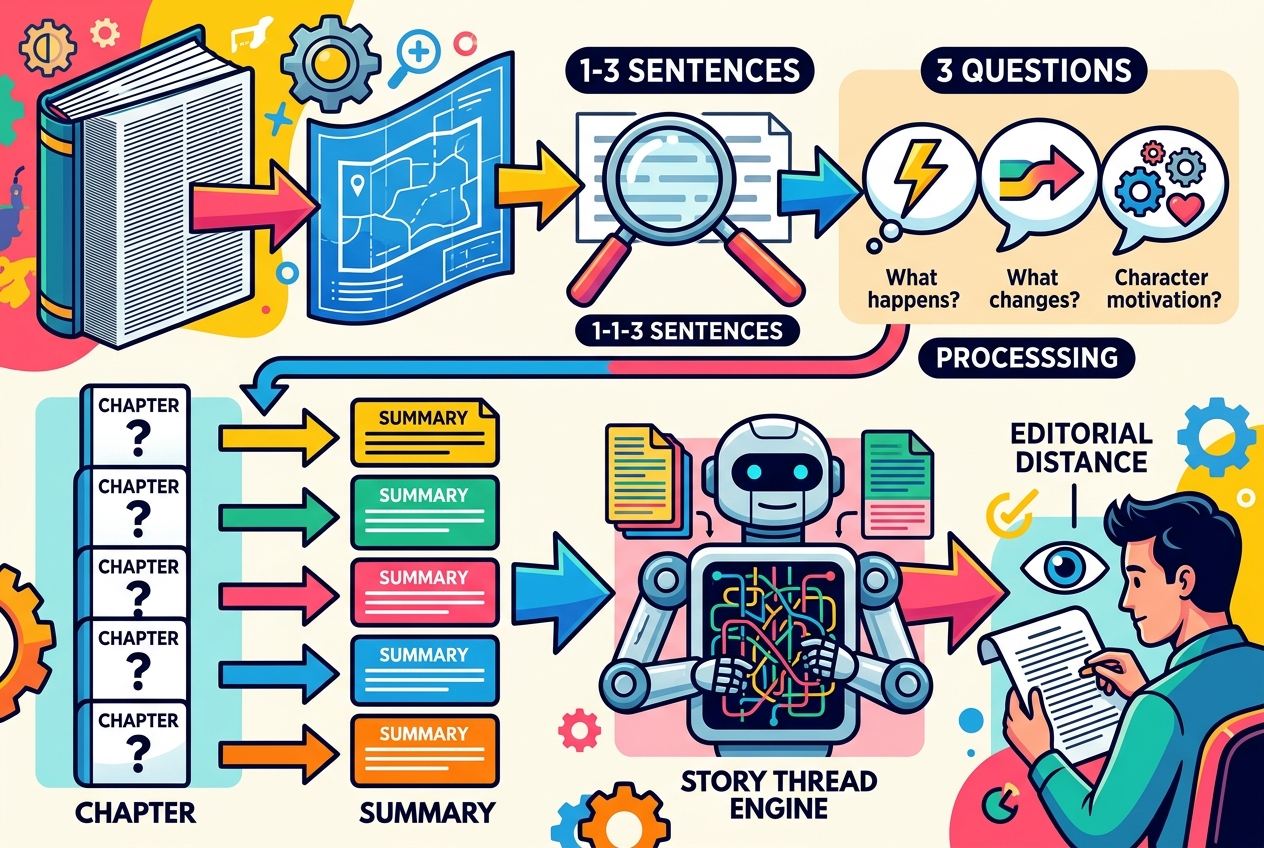
A chapter summary for AI analysis is a 1–3 sentence description of each chapter that captures what happens, what changes, and what drives each character's decisions. These summaries give AI tools a compressed blueprint of your manuscript, making it possible to spot chapters where plot progression stalls before any deep analysis begins.
A finished manuscript sitting at 80,000 words is not something any AI tool - or human editor - can absorb in one clean pass. You need to build a map first. Chapter summaries are that map.
The process is dead simple, but the discipline it requires is not. For every chapter, write one to three sentences. Not a plot recap.
Not a scene-by-scene breakdown. Three focused answers: what happens, what changes, and what is driving your characters forward (or holding them back).
That last part is where writers slip up. Summarizing events is easy. Summarizing character motivation - the internal engine behind every scene - forces you to confront whether a chapter actually earns its place in the story.
If you can't articulate why your protagonist does what she does in Chapter 4, that's not a summary problem. That's a pacing problem you just uncovered yourself, before the AI touched a single word.
Chapters that are too descriptive or lack significant plot progression become obvious the moment you line up all your summaries side by side. You'll see five chapters in a row where nothing shifts - no tension escalates, no relationship moves, no consequence lands. That pattern is invisible inside the manuscript. It's glaring in a summary list.
Here's what a useful summary looks like in practice:
- What happens - the external event. (Mira confronts Kael at the gala.)
- What changes - the shift in stakes, relationship, or information. (She discovers he knew about her brother's debt all along.)
- Character motivation - why they act as they do. (Kael stays silent because exposing the truth would destroy his leverage - and he's not ready to lose it.)
That three-part structure is what separates a useful summary from a useless one. "Chapter 7: They argue at the gala" tells the AI almost nothing. The version above gives it the raw material for macro-level pattern recognition - the kind of full-manuscript analysis where tools like BookNova AI's Story Thread Engine track narrative elements across every chapter, connecting a detail in Chapter 3 to a consequence in Chapter 15.
After reviewing manuscripts at every stage of the revision process, the summaries that fail consistently share one flaw: they describe action without capturing consequence. A scene where your heroine cries is not a pacing event. A scene where she decides to stop trusting the man she's falling for - that's a pacing event. Your summary needs to catch the difference.
Keep the language plain. These summaries are working documents, not prose. Short sentences.
Direct statements. No need for your authorial voice here - save that for the manuscript itself.
The summaries also do something useful for you as the author, independent of any AI tool: they force a ruthless editorial distance. You stop being the person who wrote the scene and start being the person who has to justify it.
Of course, a chapter-by-chapter map only gets the AI so far. Knowing what happens in each chapter is one layer of context - but AI pacing analysis also depends heavily on knowing the genre rules your story is operating inside.
Define Your Romance Tropes and Heat Level
Why Does Genre Context Matter for AI Pacing Analysis?
AI pacing tools produce far more accurate feedback when they know your romance sub-genre, core tropes, and heat level. Without this context, the AI applies universal story rules that ignore the specific beats - the slow burn, the black moment, the HEA - that romance readers expect at precise points in the narrative.
A general pacing rule says "raise tension by the midpoint." Useful. But in an enemies-to-lovers slow burn, that tension is romantic friction, not plot danger - and the two require completely different scene structures. An AI that doesn't know the difference will flag your perfectly calibrated hate-to-longing arc as stalled.
This is the story-sized pothole I see writers fall into most often. They hand the AI a manuscript, skip the context, and then wonder why the feedback feels off. The fix is dead simple: tell the AI exactly what kind of book it's reading before it reads a single page.
How to Define Your Sub-Genre and Tropes for AI
After you've built your chapter summaries, the next step is writing a short genre brief - a paragraph or two that you'll paste at the top of every AI prompt. It should cover your sub-genre (contemporary romance, dark romance, rom-com), your core tropes (enemies-to-lovers, fake dating, forced proximity), your setting, and your central character dynamic.
Tools like Authors A.I.'s Marlowe and AutoCrit go further than a prompt. They benchmark your manuscript directly against successful published books in your specific genre, flagging where your pacing diverges from what's working in the market. That's a meaningful difference from a general AI model applying one-size-fits-all story structure.
BookNova AI's Story Thread Engine takes a similar approach - it adapts to genre-specific tension arcs, handling romance tension progressions differently from mystery clue chains or thriller red herrings. Tools built with genre logic baked in require less manual instruction, though you should still provide your trope context explicitly.
Heat Level Changes Everything About Pacing
Heat level - the intensity of romantic and physical content in your book - has a direct effect on pacing expectations, and it's the detail writers most often forget to include in their AI prompts.
A slow-burn romance with a closed-door heat level should have romantic tension building across 70–80% of the manuscript before any payoff. A steamy, rapid-progression romance operates on an entirely different timeline. If you don't specify this, an AI tool will have no way to judge whether your Chapter 4 kiss is premature or perfectly placed.
Romance readers expect a recognisable structure: a meet-cute or inciting incident in chapters one and two, rising tension through chapters three to six, a crisis or black moment around chapters seven and eight, and a resolution with an HEA by the end. Where your heat level sits determines how much physical and emotional escalation belongs in each of those windows. An AI benchmarking your pacing against published romances - as Marlowe and AutoCrit do - needs to know which shelf your book belongs on.
My recommendation: write your genre brief before you touch any AI tool, not after. Include the trope by name, the heat level as a descriptor (sweet, sensual, steamy, explicit), and one sentence on the central emotional wound driving your protagonists. That single paragraph will sharpen every piece of feedback the AI gives you, from macro structure down to individual scene tempo.
Before you can fix a pacing problem, you need to see the whole road - not just the pothole you tripped over in chapter seven. Full-manuscript AI critique tools give you exactly that bird's-eye view, flagging where your story structure is quietly falling apart long before a reader notices and puts the book down. You'll discover which AI tools are built to handle an entire romance manuscript in one go, and how to ask the right questions to get feedback that actually means something.
The Big Picture AI Story Critics
What Are AI Developmental Critique Tools for Full Manuscripts?
AI developmental critique tools are purpose-built platforms that analyse an entire romance manuscript - typically 80,000 words or more - for structural issues including pacing, plot arc, character development, and genre conventions. Unlike general AI models, they are trained specifically on long-form fiction and deliver editorial-level feedback in minutes.
A general-purpose AI like ChatGPT loses the plot - literally - somewhere around 8,000 to 16,000 words. Feed it your full manuscript and it starts forgetting character names, missing planted foreshadowing, and treating chapter 22 like it never read chapter 3. That's a story-sized pothole you cannot afford at the diagnostic stage.
Specialised tools exist precisely because full-manuscript analysis demands a different kind of engine. Three stand out for post-draft romance work: Inkshift, Authors A.I.'s Marlowe, and AutoCrit.
Marlowe: The Benchmark Reader
Marlowe is built exclusively for long-form fiction, with a minimum submission threshold of 20,000 words. It evaluates plot structure, character development, pacing, dialogue balance, theme, and genre conventions - then benchmarks your manuscript against thousands of published novels. Not generic novels. Published books in your specific genre.
For romance, that matters enormously. Marlowe knows that readers expect a meet-cute or inciting incident by chapters 1 to 2, rising tension through chapters 3 to 6, a crisis or black moment around chapters 7 to 8, and a resolution with an HEA by chapters 9 to 10. If your enemies-to-lovers couple is still circling each other in chapter 8 with no black moment in sight, Marlowe flags it - with data behind the call, not just editorial instinct.
Inkshift: The Structured Report
Inkshift delivers something particularly useful for writers who feel overwhelmed by open-ended feedback: a structured revision plan. Its reports categorise issues into major and minor revisions, so you know immediately whether you're dealing with a foundational structural problem or a surface-level fix. That distinction alone saves hours of second-guessing.
Both Inkshift and Marlowe can analyse an 80,000-word manuscript and return in-depth feedback within 15 minutes to a few hours. Compare that to a human developmental editor, who typically spends 75 to 100 hours on a manuscript of that length before the author even sees notes.
AutoCrit: The Genre Rhythm Reader
AutoCrit operates more like a digital beta reader than a structural editor. Its strength is identifying the subtle rhythm of your story - the ebb and flow of tension that readers feel but rarely articulate - and comparing it against successful romance novels. It catches the kind of mid-book drag that focus groups miss because they can't quantify it.
| Tool | Best For | Minimum Length | Key Output |
|---|---|---|---|
| Marlowe | Genre benchmarking, structural arcs | 20,000 words | Comparison against published novels |
| Inkshift | Actionable revision planning | Full draft | Major/minor revision categories + plan |
| AutoCrit | Story rhythm, pacing feel | Full draft | Genre-specific pacing benchmarks |
Choosing the right tool is half the battle. The other half is knowing how to talk to it - and what exactly to ask for when you need it to look at your full story arc from the opening chapter to the HEA. The prompts you craft will determine whether these tools surface the real problems or skim the surface.
How Do You Prompt AI to Analyze Your Romance Manuscript's Overall Story Arc?
To analyze your romance manuscript's overall story arc, prompt an AI developmental tool to act as a developmental editor and evaluate macro-pacing across your full manuscript - checking where tension builds, where it collapses, and whether your plot beats align with core romance genre conventions like the meet-cute, rising tension, crisis, and HEA.
A vague prompt gets vague feedback. That's the single most important thing to understand before you type a single word into any AI tool. The difference between "what do you think of my pacing?" and a well-constructed developmental prompt is night and day - one gives you a polite non-answer, the other gives you a structural diagnosis.
Before you write a single prompt, you need your chapter-by-chapter summaries ready. One to three sentences per chapter: what happens, what changes, what each character wants. This is the raw material the AI works from at the macro level, and skipping it means the tool is flying blind.
Here's how to build prompts that actually work:
- Assign the AI a Role - Start every macro-pacing prompt with a clear instruction: "Act as a developmental editor specialising in romance fiction." This frames the entire response. Without it, you get generic feedback. With it, the AI filters everything through the right professional lens.
- Define Your Genre Context - State your sub-genre, tropes, heat level, and character dynamics explicitly. An enemies-to-lovers slow burn has completely different pacing expectations than a rom-com. Write something like: "This is a contemporary enemies-to-lovers romance with a slow burn. The expected beats are: meet-cute in chapters 1–2, rising tension through chapters 3–6, a black moment in chapters 7–8, and an HEA resolution in chapters 9–10." Tools like Marlowe benchmark against published novels automatically, but even then, spelling this out sharpens the output.
- Ask for Tension Mapping - Instruct the AI to identify specifically where tension escalates and where it falls flat. A prompt like: "Using the chapter summaries below, identify three moments where tension builds effectively and three where it stalls or deflates. Explain why each one works or doesn't." This forces concrete, scene-referenced feedback rather than vague impressions.
- Request a Plot Structure Audit - Ask the AI to compare your actual story beats against the romance conventions you defined. Something like: "Compare my chapter progression against standard romance pacing. Flag any chapters that feel structurally out of place, rushed, or too drawn out."
- Ask About Character Arcs Separately - Pacing and character arcs are connected, but they're not the same thing. A dedicated prompt - "Evaluate whether my two leads show consistent emotional growth across the arc. Where does their development feel stalled?" - pulls out feedback that a general pacing question will bury.
One thing I'd push back on: don't ask the AI to fix everything in one prompt. Separating tension analysis from character arc feedback from plot structure keeps the responses focused and genuinely useful. Cramming it all into one question produces a wall of text that's hard to act on.
The same principle applies when you later start drilling into individual scenes - specificity at the prompt level determines the quality of what comes back. That's true whether you're looking at the whole manuscript or a single chapter where your hero refuses to say the obvious thing for forty pages (we've all written that chapter).
For full manuscripts over 80,000 words, purpose-built tools like Inkshift or Marlowe handle this kind of structural analysis without the context-window limitations that trip up general models - Marlowe can deliver a full in-depth analysis in under 15 minutes, which is genuinely absurd compared to the 75–100 hours a human developmental editor typically logs on a manuscript that size.
Big-picture pacing problems get all the attention, but the real work happens at the scene level - where a single dragging exchange or an over-explained emotional moment can quietly bleed the tension out of your entire manuscript. Think of it like hitting a story-sized pothole you didn't see coming: the journey doesn't stop, but the reader feels every bump. Here, you'll learn how to hand a slow, sluggish scene to an AI model and get something sharper back - without losing the emotional heartbeat that makes romance worth reading.
Trimming the Fat from Slow Scenes
Slow scenes don't announce themselves. They just sit there, quietly bleeding your reader's attention until she puts the book down - and doesn't pick it back up. You've already done the hard work of identifying which scenes dragged in your macro-analysis. Now comes the surgical part.
Scene tightening means cutting or condensing anything that doesn't push the romance forward - emotionally or plot-wise. Every sentence either earns its place or it doesn't. There's no middle ground in a genre where readers are here for the feeling, not the furniture description.
The most direct AI prompt I've found for this is deceptively simple. Copy your slow scene into ChatGPT or Claude and type: "Rewrite this scene to improve pacing - trim the fat, combine elements where possible, and reframe the core conflict so it lands harder." What comes back won't be your final draft, but it will show you what's possible when 200 words of circular internal monologue becomes 40 sharp ones.
Here's the practical workflow:
- Isolate the Scene - Copy only the flagged scene into your AI tool. Don't paste the whole chapter. General models like ChatGPT work best under 10,000 words, and giving it less context means it focuses on what you actually need fixed.
- Run the "Cut to the Chase" Prompt - Ask the AI to rewrite for pacing, specifically requesting that it trim excess description, combine dialogue with action beats, and sharpen the central conflict. Review the output as a diagnosis, not a replacement.
- Apply the Show, Don't Tell Converter - Telling is when you write "She was nervous." Showing is when her hands won't stop smoothing her dress and she laughs two seconds too late. Paste over-explained emotional moments and prompt: "Convert this from telling to showing using sensory details and physical reactions." This one technique alone can cut word count while making a scene feel more alive.
- Combine Dialogue and Action - Slow scenes often separate talking from doing. Characters stand still and chat. Ask the AI to weave movement, gesture, or environmental detail into the dialogue so both things happen at once. A AI for romance banter approach works well here - the goal is subtext carried through action, not just words on a page.
- Protect What Matters - Before you accept any AI rewrite, tell it explicitly what cannot change. "The tension between these two characters is not resolved in this scene." AI is trained to solve problems, which means it will tidy up conflicts you need left deliberately messy. Guard your story-sized potholes - some of them are load-bearing.
One thing worth flagging: the Show, Don't Tell pass often does double duty. It tightens prose and shifts the emotional register of a scene in ways that ripple outward - affecting how the next scene lands, and the one after that.
My honest opinion? Most writers over-explain the moments that should hit hardest. The enemies-to-lovers almost-kiss doesn't need three paragraphs of her cataloguing why this is a terrible idea.
Readers already know. Cut it to one devastating sentence and let the silence do the work.
Tightening a scene changes its texture - but texture is only part of what controls how a reader feels moving through your story.
How Do You Control the Emotional Flow Within a Romance Scene?
Controlling emotional flow means deliberately varying the speed and intensity of a scene so readers feel tension build and release at the right moments. In romance, this requires instructing your AI to shift between slow, character-focused passages and fast, high-stakes moments - rather than letting every scene run at the same flat pace.
Trimming slow scenes gets you a leaner manuscript. But a lean manuscript isn't automatically a gripping one. Once the excess is gone, the real craft work begins: shaping emotional tempo, the rise and fall of intensity within and between scenes that keeps a reader's pulse unsteady in all the right ways.
AI handles this well when you give it explicit gear-shift instructions. Vague prompts produce vague results. Specific ones don't. Compare these two approaches:
- "This scene is a breath. Slow, character-focused, no plot advancement - let Mira sit with her feelings."
- "Now things speed up. Short sentences, quick cuts between locations, no lingering interiority."
Those aren't stylistic suggestions. They're tempo directives, and a well-prompted AI will execute them with surprising precision. You're essentially conducting - telling the orchestra when to go quiet and when to swell.
The bigger challenge is conflict. AI is trained to solve problems, which makes it a genuinely terrible instinct for romance pacing. Left to its own devices, it will introduce a conflict and resolve it within the same scene.
Enemies-to-lovers runs on unresolved tension for chapters at a time - that's the entire engine of the trope. An AI that keeps tidying things up will sand off every sharp edge your story needs.
The fix is blunt and non-negotiable: protect your unresolved conflicts explicitly in the prompt. Something like, "The tension between Mira and Kael is not resolved in this scene. They're still circling the issue. Do not let them reach an understanding." That instruction needs to be in the prompt every single time you work on a scene where the conflict should stay open, because AI has no memory of what you told it last session.
Beyond that, every scene should either make things worse or make them different - not better, not resolved. That's the underlying principle. A scene where Mira and Kael argue and part on worse terms than before?
Good. A scene where they argue, almost kiss, and then one of them says something cutting that reopens an older wound?
Even better. That's complication, not resolution, and it's what builds the anticipation romance readers are actually there for.
This is also where prose-level choices start to matter - word rhythm, sentence length, the weight of a single line of dialogue - though that's a layer of refinement that sits just underneath everything discussed here. The structural tempo work comes first.
One practical note: if you're working with a general AI model like ChatGPT or Claude rather than a dedicated fiction tool, paste in your conflict protection instructions at the top of every new prompt. Context windows on these models typically cap out between 8,000 and 16,000 words, which means the AI genuinely forgets earlier instructions. Repetition isn't redundancy here - it's maintenance. For AI romance dialogue work within these same scenes, the same rule applies: restate your character dynamics every time.
A scene that ends with tension intact is almost always more powerful than one that ends with it resolved.
Once the big structural fixes are in place, the real polish happens at the sentence level - and this is where many writers hit a story-sized pothole they never saw coming. Flat rhythm, weak verbs, and dialogue that just sits there instead of sparking can quietly drain a scene of all its momentum. Here, you'll discover how AI can act as a sharp-eyed diagnostic tool for your prose, helping you spot patterns that dull your pacing - without steamrolling the voice that makes your writing unmistakably yours.
How Do You Use AI to Improve Sentence Rhythm and Word Choice in a Romance Manuscript?
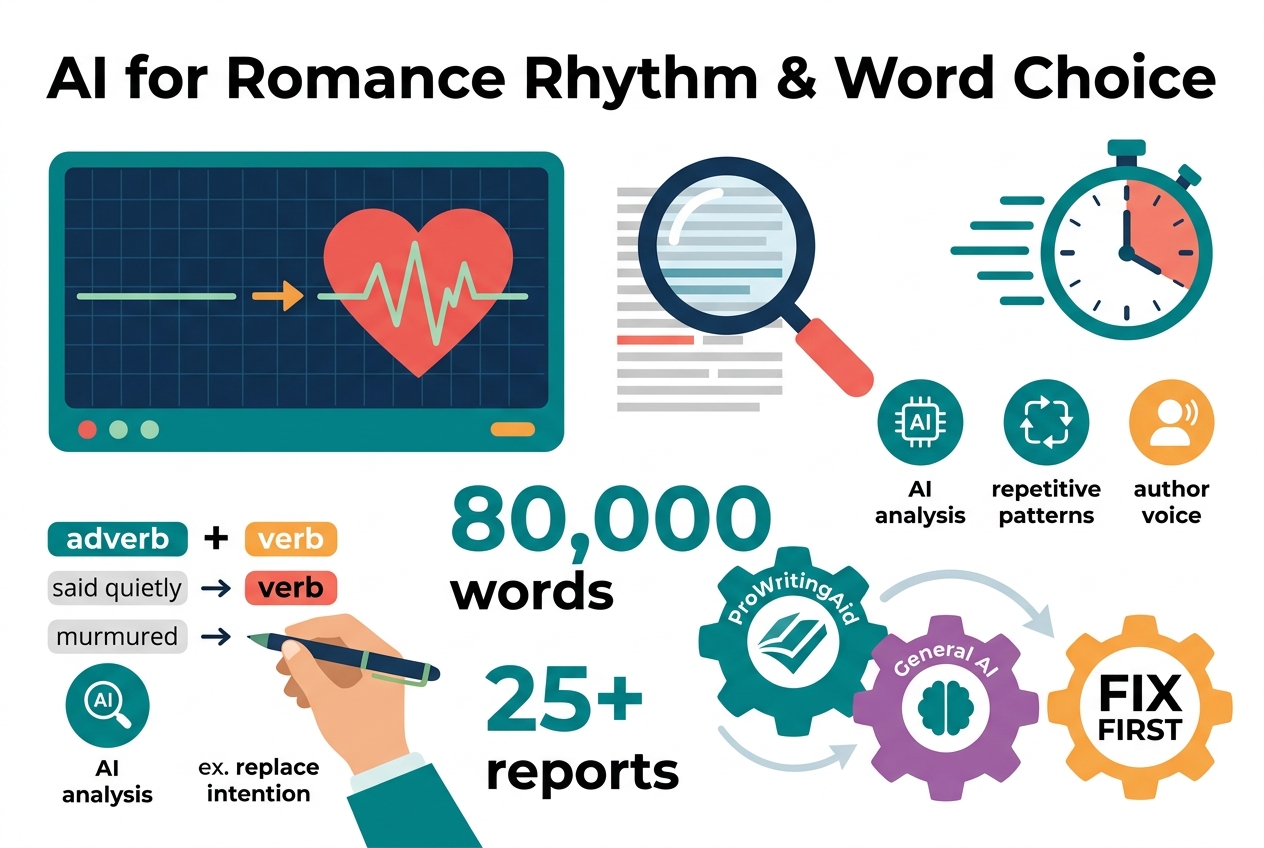
A sentence rhythm audit uses AI to analyze the structure, length, and opening words of every sentence in your manuscript, revealing repetitive patterns that flatten prose. By pairing this with an adverb-to-verb replacement pass, you tighten your writing and restore the natural heartbeat readers feel - often without knowing why they're hooked.
Scene-level pacing gets the spotlight, but sentence rhythm is where readers either lean in or drift away. A chapter can have perfect tension on paper and still read like a car with a misfiring engine - technically functional, but uncomfortable to ride.
The fix starts with a specific AI prompt: ask for a sentence variation audit. Request that the AI list the first five words of every sentence in a passage. What comes back is often alarming.
You'll see the same subject-verb opener repeated a dozen times in three pages - "She turned," "She looked," "She felt." Spotting that pattern manually takes hours. AI surfaces it in seconds.
After the variation audit, run the adverb pass. Instruct the AI to list every adverb in the manuscript - particularly those ending in -ly. "He said quietly" becomes "he murmured." "She ran quickly" becomes "she sprinted." Each swap is a small gain, but across 80,000 words, the cumulative effect on pace and energy is significant. Weak adverbs are a sign that the verb underneath isn't doing its job.
ProWritingAid handles this kind of diagnostic work particularly well. It offers over 25 reports on writing habits, covering readability, sentence length variation, and style patterns - all in one place. For a romance writer who's already done the scene-level work, these reports function as a detailed X-ray of your prose habits. You'll see exactly where your sentences cluster in length, where your word choices go flat, and which paragraphs need restructuring.
One thing worth flagging before you go deep into AI-assisted rewrites: the question of authorial voice sits at the center of every AI editing decision you make. That's a conversation worth having carefully - and one that intersects with broader questions about human judgment in the revision process.
For AI romance dialogue, rhythm matters just as much as word choice. Banter that clips along in short exchanges creates a different emotional texture than long, winding internal monologue - and AI can flag when you've accidentally let one bleed into the other.
The obvious instinct is to let the AI rewrite flagged sentences directly. Resist it. Use AI to identify the problem, then fix it yourself.
An AI-generated rewrite is a suggestion, not a solution. Your voice is the thing that makes readers pre-order your next book before they've finished the current one.
ProWritingAid's readability report, cross-referenced with a sentence-opening audit from a general AI model, gives you a diagnostic picture that no single tool produces alone. Run both. Compare the output. The overlapping problems are the ones to fix first.
How Do You Sharpen Dialogue and Inner Monologue Using AI?
AI sharpens dialogue and inner monologue by analyzing whether each exchange advances your characters' emotional arc, reflects their distinct personalities, and carries sensory weight. Tools like SudoWrite specialize in expanding flat conversational beats into vivid, grounded scene moments that feel lived-in rather than written.
Dialogue that just moves plot is dead weight. The best romance banter does three things at once - it reveals character, builds or releases tension, and advances the emotional arc without the reader noticing the machinery. AI is surprisingly good at diagnosing when your dialogue is only doing one of those three.
A simple prompt gets you far: paste a conversation into ChatGPT or Claude and ask, "Does this exchange reflect each character's distinct voice? Where does it feel generic?" You'll often get back something uncomfortable - a list of lines that could belong to any character in any romance novel. That's your story-sized pothole right there.
For AI romance dialogue, SudoWrite is the tool I'd point beginners toward first. It's built for narrative fiction specifically, and it excels at two things the research brief flags directly: sensory descriptions and expanding summary-level writing into detailed scene beats. A flat line of dialogue like "He looked away" becomes a moment with texture - the smell of coffee going cold, the specific way he sets down his cup.
That's not decoration. Sensory grounding slows the reader's eye at exactly the right moment.
Inner monologue is the harder fix. It's where pacing quietly bleeds out, sentence by sentence, because characters over-explain their own feelings. Ask AI to flag any internal thought that states an emotion directly - "She felt nervous" - rather than showing it through physical sensation or fragmented reasoning. The fix is almost always tightening, not expanding.
A useful prompt structure for deepening character voice in internal thoughts: "Rewrite this internal monologue so it sounds like [character name], who is [two or three defining personality traits]. The emotion being conveyed is [emotion], but she should not name it directly." That constraint forces the AI toward subtext, which is where real emotional resonance lives.
Balancing dialogue tags - the "he said / she said" markers around spoken lines - is another area where AI earns its keep. Too many action beats slow the pace; too few and readers lose the scene's physicality. Prompt the AI to audit a scene's tags specifically, separate from the dialogue itself. It's a small thing that compounds fast across a full manuscript.
One honest caveat worth planting here: AI reads patterns, not people. It can tell you a line of dialogue is generic, but it cannot tell you whether that generic line is doing something quietly essential for your specific character's arc at that specific moment in the story. That gap - between what the AI flags and what the manuscript actually needs - is where every single suggestion has to pass through your judgment before it touches the page.
AI can flag a sluggish chapter or spot a tension problem in minutes, but it cannot feel the difference between a moment that lands and one that falls flat - and in romance, that difference is everything. No matter how useful your AI tools have been up to this point, the final say always belongs to you. Here, we'll look at the very real risk of losing your voice when you lean too heavily on AI suggestions, and why a proper human read-through is the step you simply cannot skip.
Don't Let AI Steal Your Voice
Hand your manuscript to an AI without clear boundaries, and you'll get it back grammatically flawless - and completely unrecognizable. That's not an exaggeration. It's the most common complaint I hear from romance writers who dove into AI editing headfirst.
AI struggles with subtext - the unspoken tension, the loaded silence, the moment where love and fury exist in the same breath. Those contradictions are the entire engine of a good enemies-to-lovers arc. An AI doesn't feel them. It sees a logical inconsistency and tidies it up.
Worse, it will sometimes strip out your intentional stylistic quirks - the fragmented sentence you used for punch, the run-on that mirrors your heroine's spiraling anxiety - and replace them with something technically correct and completely dead on the page. Grammatically perfect prose is not the same as emotionally alive prose. Not even close.
How to Review AI Suggestions Without Losing Yourself
The fix isn't to use AI less. It's to use it differently. Every suggestion the AI gives you is a question, not a command. Ask yourself: does this change serve my character's arc, or does it just make the sentence tidier?
Run a quick mental checklist before accepting any AI rewrite:
- Does this still sound like my narrator, or has it gone generic?
- Has any emotional ambiguity been smoothed away that was actually intentional?
- Did the AI resolve a tension I specifically needed to stay unresolved?
- Would my beta readers recognize this scene as mine?
That last question is the one writers skip. Your beta readers - and eventually your readers - came to you for your voice. Not a cleaner version of it.
Tools like editGPT are built specifically to rewrite prose while preserving authorial voice, which is a step in the right direction. But no tool is foolproof. Your human review pass - the one where you read the revised draft aloud and wince at anything that sounds off - is what actually catches the damage. That pass matters more than any AI run you do before it.
One opinion I'll stand behind: using AI as a ghostwriter for your emotional beats is a mistake, full stop. Use it to find the story-sized potholes - the structural drag, the rushed chapter, the scene that stalls your third act. Then fix those problems in your own words. The AI for romance series conversation is full of writers who got this backwards and spent months undoing the damage.
AI is a diagnostic tool. A very good one. But diagnosing a problem and solving it are two different jobs, and only one of them requires a human heart.
The authors who get the most out of AI editing are the ones who treat every suggested rewrite as a first draft - something to react to, argue with, and ultimately remake in their own image. That friction is where your voice survives.
The Essential Human Read-Through
After AI analysis, a final human read-through is the non-negotiable last step before your manuscript is ready. AI catches structural patterns, but only a human reader can verify emotional resonance, subtext, and the subtle logic of a relationship unfolding - the elements that make a romance novel actually work.
You already know AI struggles with subtext and voice. That limitation doesn't disappear after you've run your manuscript through every tool on the list. A scene where your heroine's anger masks her fear?
AI sees two emotions in conflict and flags it as inconsistent. You know it's the whole point.
This is why the final human read-through isn't a nice-to-have. It's the last line of defence between your story and a reader who will put it down without finishing it.
The Real Cost of Skipping It
Traditional editing of an 80,000-word manuscript takes 4 to 8 weeks across multiple passes - developmental, line editing, copy editing, proofreading. AI compresses the early analysis stages dramatically, but the human revision work that follows still takes real time. A competent editor works at roughly 1,500 words per hour for line editing. Do the maths on 80,000 words.
Skipping your own careful read-through doesn't save that time. It just pushes the problem forward - to a beta reader, a professional editor, or worse, a one-star review.
Who Should Read Your Manuscript
Editing is an iterative process: revise, test, repeat. That loop has layers, and each layer needs a different set of eyes.
| Reader Type | What They Catch | When to Use Them |
|---|---|---|
| You (fresh read) | Pacing gaps, emotional flatness, voice drift | After every major AI revision pass |
| Beta readers | Reader experience, genre expectation mismatches | After your own read-through is clean |
| Professional editor | Structural issues, line-level prose, continuity | Final pass before submission or publication |
Beta readers are underrated at this stage. They read your book the way your actual audience will - without knowing what you intended, without your defensive instinct to explain away a slow chapter. A beta reader who reads enemies-to-lovers romance every week will tell you immediately if your black moment lands or just feels like a detour.
A professional editor is a different investment entirely. At 1,500 words per hour for line editing, a 75,000-word manuscript represents roughly 50 hours of billed time. AI work done beforehand - cleaning up easy errors, tightening obvious pacing problems - can meaningfully reduce that number. That's one of the most practical financial arguments for using AI tools correctly.
What You're Actually Checking For
Your human read-through isn't a grammar pass. Grammarly handles grammar. You're reading for the things AI genuinely cannot evaluate: does the slow burn feel earned, or just slow? Does the reconciliation after the black moment feel true to these two specific people, or does it feel like a plot requirement being satisfied?
I've read manuscripts where every pacing metric looked clean on paper and the story still felt hollow. No AI report will flag "the reader doesn't care yet." Only a human reader notices that.
Set the manuscript aside for at least a few days before your read-through. Fresh eyes catch what tired ones miss - and after weeks of revision, your eyes are anything but fresh.
Conclusion: What Does AI Actually Do for Your Romance Manuscript's Pacing?
AI acts as a co-pilot for diagnosing and fixing pacing issues in a completed romance manuscript - scanning structure, flagging slow scenes, and refining prose - but the emotional heart of your story always stays in your hands.
AI does not write your romance. It reads it faster than any human can, spots the story-sized potholes before your readers do, and hands you a map of where the road went wrong. What you do with that map is entirely yours.
Here is what this process actually looks like, stripped back to its essentials:
- Prep before you prompt. Chapter summaries and a clear definition of your tropes and heat level are not optional housekeeping - they are the instructions that make AI feedback specific and useful instead of generic.
- Macro first, micro second. Specialized tools like Marlowe or Inkshift can analyse an 80,000-word manuscript in minutes - a job that takes a human developmental editor 75–100 hours. Use that speed to find structural problems before you spend hours polishing individual sentences.
- Protect your unresolved tension. AI is trained to solve problems. Your romance is built on problems that linger. Explicitly tell the AI what it is not allowed to fix.
- Combining AI analysis with human revision can cut your total editing time by 50% or more - but only if you do the human revision. Accepting AI rewrites without reading them critically is how voices go flat and characters go missing.
- The final read-through is non-negotiable. AI cannot feel the moment a vulnerable scene earns its place in a character's arc. You can.
Your next step today: pick one chapter your beta readers flagged as slow, copy it into ChatGPT or Claude, and prompt it to act as a developmental editor - ask it to identify where tension drops and why. See what it finds.
If you want to work at full-manuscript scale from the start, BookNova AI's Story Thread Engine tracks romance tension arcs across your entire book, keeping every subplot and character thread consistent chapter to chapter.
AI gives you the diagnosis. The cure is still your job.